
Dry Curly Hair: How to Work Out What Is Causing It
Ishant Sharma
Quick Summary
Dry curly hair is not one problem. It is at least six, and they wear the same word. Hair that looks dull, hair that feels rough, hair that snaps, hair that feels coated, hair that flakes at the scalp and hair that only behaves on wash day all get called dry, and they need completely different answers.
None of the six is simply about water. The closest is breakage in very tight coils, and even there water is a strength argument rather than a softness one. Measurements put the water in a hair fiber at around a tenth of its weight at about 50 percent humidity, and half again as much on a humid day. The number tracks the room more than anything you put on your head. In hand-feel tests, most people picked the strands holding more water as the dry ones.
This guide helps you work out which of the six is yours before you buy anything else. It is a diagnosis, not a routine. Where you need the routine, our existing guides are linked in the right places.
| What you notice | What it usually is | Is it a water problem? |
|---|---|---|
| Looks dull in photos but feels soft | Light scattering, not dryness | No |
| Feels rough, coarse or like straw | Surface and lipid condition | No |
| Snaps, ragged ends, never gains length | Breakage | Partly, for tight coils |
| Feels stiff, coated or heavy | Product or mineral deposit | No |
| Rough and porous mainly toward the ends | Heat or chemical damage | No, damaged hair takes up more water |
| Flaking or itching at the scalp | A scalp condition, not hair dryness | No |
If what you actually have is a surface problem, a leave-on cream changes how your hair feels more than adding water ever will. Start with the plant-based hair butter, or browse everything we make for curls in curls.
What do you mean when you say your hair is dry?
This sounds like a pedantic question. It is the most useful one on this page.
When people say dry, they are describing one of six quite different experiences. Hair that photographs dull. Hair that feels like straw in the hand. Hair that breaks. Hair that feels coated. Hair that misbehaves within hours of a wash. A scalp that flakes.
Those have different causes and different answers. A reader with light scattering buys a deep conditioner and gets nothing, because nothing was wrong with the condition of their hair. A reader with breakage buys more moisture and keeps losing length, because moisture does not mend a fracture.
Start with what you can observe
Pick the line in the table above that matches what you actually see and feel, then read that section. You are allowed to match more than one. Most people do.
The one thing not to do is assume the answer is water, because that is the assumption the whole category is built on, and it is the one the measurements do not support.
Is dry curly hair actually short of water?
Almost never, and this is worth sitting with before you spend anything.
How much water is in a hair fiber
When researchers put hair in a controlled humidity chamber and weigh it, they find water making up roughly a tenth of its weight at about 50 percent humidity. In one study measuring across hair types, the figures came out at 10.68 percent for African hair, 10.65 percent for Asian hair and 11.24 percent for Caucasian hair.
Look at what that does and does not show. The spread is about half a percentage point, and it does not line up with curl at all. Straight Asian hair and coiled African hair measured the same. Half a percentage point does not feel like straw.
The room matters more than the product
That number is not fixed. It rises and falls with the humidity of the air around you, continuously. This is the same physics behind frizz on a humid day.
Ordinary conditioners do not measurably shift it. A few specialist treatments have been shown to move it, in both directions. Nothing on a shelf overrides the room.
Which means the water content of your hair this afternoon is mostly a fact about the weather, not about your routine.
The blind test where the wetter hair was called dry
Here is the finding that should change how you shop.
Researchers conditioned hair tresses at 80 percent humidity and at 15 percent humidity, so one set held more than four times the water of the other. Asked to judge them by hand, three in four assessors picked the drier tresses as the more moisturized, smoother and less damaged ones.
Separate work points the same way. Bleached hair was measured holding more water than virgin hair at every humidity from 10 to 90 percent, and people still described it as the drier, more damaged hair. Conditioning does not measurably change water content either, yet it reliably changes what people call moisturized.
In another panel, 41 consumers could not reliably tell moisturizing treatments from an untreated control at all. The researchers concluded that sensory judgement is not a usable way to assess hydration.
Whatever people are sensing when they say dry, it is not how much water is in the fiber.
The one case where water genuinely matters
There is an honest exception, and it is specific to tight coils. In single fiber strength testing, keeping water in the fiber has been associated with less premature fracture in very coily hair.
Note what that is and is not. It is a strength argument, not a softness argument. Water may help your hair survive handling. It is not what makes it feel good.
This is also early work, done on single fibers and partly on relaxed hair, and the people who ran it describe it as preliminary.
Is dry hair the same as dehydrated hair?
You will see a neat split: dry hair lacks oil, dehydrated hair lacks water, and each needs a different product. It is a tidy idea and it does not come from the science.
That split does not appear as a category in the cosmetic science literature. It appears on brand blogs and in salon training.
It also gets both halves backwards for curly and coily hair. On the oil side, afro-textured hair measures lipid rich, not lipid poor. One study put total lipids at about 6.75 percent of fiber weight, against roughly 2.1 and 2.7 percent for the Asian and Caucasian hair it was compared with. On the water side, the measured differences are tiny and the blind tests point the wrong way.
What the measurements actually separate
| What it is | What it means | Can you change it? |
|---|---|---|
| Water content | Water held in the fiber, around a tenth of its weight at 50 percent humidity | Barely. It tracks the humidity of the room |
| Surface and lipid condition | How smooth the cuticle is and what sits on it | Yes. This is what people feel as dryness |
| Structural integrity | Damage, weakness, fracture | Partly, by prevention. Not reversible |
The distinction people are reaching for is real. It is just not dry versus dehydrated. It is how your hair feels and looks versus how much water is in it, and those two have been measured moving in opposite directions.
Does curly hair really produce less oil?
No. This is the most repeated claim about curly hair, and it is measurably false.
What a study of 1,325 people found
Researchers measured scalp oil on 1,325 people across seven groups, using an instrument on small shaved scalp areas at set intervals after shampooing. At the settled, everyday level, the highest amount of sebum sitting on the scalp was measured in the African American participants. The study puts the spread down to both gland output and washing routines.
Highest. Not lowest. If your scalp gets oily while your ends feel like straw, you are not imagining a contradiction. You are describing the actual situation.
Distribution, not production
So the oil is there. The problem is where it ends up.
Here is the part that needs stating carefully, because the usual explanation is wrong. Sebum does not travel along any hair shaft, straight or coiled. It transfers onto whatever hair touches the scalp and the surfaces nearby. Dermatology texts hold that tight coils put less of the length in contact with those surfaces, so less of it gets coated.
Note the evidence grades. The high output is measured. The poor coverage along the length is expert reasoning, because nobody appears to have measured oil along fibers of different curliness.
Why this matters for what you buy
The familiar story is that oil slides down a straight shaft and gets stuck on the bends of a curly one. Since sebum does not slide down any shaft, that story is wrong about straight hair too.
Which matters practically. If you have been waiting for your natural oils to work their way down, they were never going to. Anything that coats the length has to be put there.
One more piece of folklore to drop while we are here. Washing more often does not make your scalp produce more oil. That idea has been tested and ruled out.
Why do your curls look dry when they feel soft?
Because looking dry and being dry are two different measurements, and only one of them involves your hair's condition.
How shine is actually measured
Shine is a ratio. Light that bounces off a surface in one direction reads as shine. Light that scatters in all directions reads as dull. Laboratories measure the ratio between the two.
Several things push that ratio down. A disrupted cuticle scatters light. Residue on the surface scatters light. And the factor nobody mentions is alignment, which measures as important as the depth of your hair color and far more important than anything you can buy.
Why alignment changes how dry your hair looks
Hair that lies flat and parallel forms a smooth surface for light to bounce off. Hair that fans out in every direction does not. A curl pattern is, by definition, not aligned.
This is why the same head of hair photographs dull loose and glossy when stretched or clumped, with nothing having changed about its condition. It is also why straightened hair looks shinier even when the heat has damaged it.
Why misting can make curls look worse
If your hair looks rougher right after you spray it, that is real. Immersing hair in water has been measured to raise the cuticle scales by more than half again, which makes the surface bumpier and grippier.
So adding water can genuinely make hair look and feel drier for a while. The one instinct everybody has is the one that backfires soonest.
Is it dryness, or is it breakage?
This is the reframe that changes the most for the most people, and no one in this conversation talks about it.
What the length of your shed hairs tells you
Researchers collected hairs lost during washing and measured them. The average length came out at 54 millimeters for the African hair in the study, against 219 and 250 millimeters for the Caucasian and Asian hair.
Length alone does not prove anything, because it also depends on how long people wear their hair. The ends do. A fiber shed at the end of its growth cycle has a club shaped root. In that study the African fibers mostly had fractured ends instead, at the root and at the tip, which is the signature of breakage rather than shedding.
Why tightly coiled fibers fracture sooner
The fiber has a flattened, oval cross section and grows from a curved follicle, which leaves it less able to withstand being pulled straight. It carries more knots, and in the comparisons that exist it takes less force to break, though researchers note that tensile testing was designed around straight hair and may understate what curly fibers can take.
Every bend is a place where force concentrates. Detangling applies that force repeatedly.
Signs you are losing length rather than moisture
Ends that look ragged however often you trim. Hair that sits at the same length year after year. Short broken pieces in the sink that are nowhere near the length of your hair.
If that is you, no conditioner will fix it, because nothing was dry. Our guide to how to stop hair breakage on curly hair covers retention properly, and peptides for hair growth covers the growth side if that is the other half of your problem.

Is something sitting on your hair instead of in it?
Deposits make hair feel exactly like dryness feels. Stiff, rough, unresponsive. The cause is the opposite of a shortage.
What buildup does, and what it does not
Conditioning polymers and styling films are designed to cling, and they accumulate in layers over consecutive days. That leaves hair stiff, rough and heavy.
What they do not do is block water from entering your hair. The cuticle has far too many gaps for any coating to seal it, and water content tracks the air regardless. If you have been told buildup is suffocating your hair, the symptoms are real and the mechanism is not.
The tell is timing. Buildup gets worse across non wash days and resets dramatically after a proper clarifying wash. If that pattern sounds familiar, clarifying shampoo for curly hair is the place to start.
What hard water has actually been measured to do
Mineral deposition is real and measured. In one study, hair washed in hard water carried noticeably more calcium and magnesium than hair washed in distilled water.
Beyond deposition the evidence thins out fast. Studies disagree on whether hard water weakens hair, one found no effect on elasticity, and we could not find a single published study testing whether it changes how dry hair feels.
What has been measured is that calcium and magnesium inside the fiber stiffen it. In that same study the stiffening made hair slightly easier to comb and better at holding a style. So stiffness is the finding, not damage.
The honest version: if your water is hard, minerals are on your hair, and stiffness is a reasonable thing to suspect. Our guide to hard water and curly hair goes further.
Is it damage from heat or color?
This is the cleanest case of something that is not dryness at all.
Damaged hair absorbs more water, not less
Chemical processing breaks bonds inside the fiber and leaves behind groups that attract water. Healthy hair has a water repellent surface. Damaged hair becomes water loving and takes up more water, measured at around 45 percent of its weight at saturation against about 30 percent for undamaged hair.
Read that again if you have been treating damage as a moisture shortage. The damaged hair in your head is the wettest hair in your head.
Why the ends are always worse
Damage accumulates. Your ends have been through every wash, every detangle and every hot tool since they grew. Your roots have not.
That is why most people have two different hair types on one head, and why a product that suits your roots can feel wrong on your ends.
What cannot be undone
Worth saying plainly, because the category rarely does. Bonds broken by bleach or a relaxer do not grow back. Products can smooth the surface, reduce friction and make damaged hair behave better. They do not repair the inside.
Our guide to heat damage in curly hair covers what is worth doing and what is marketing.
Can porosity explain it?
Partly, and less than you have been told.
Two different things share the word
One is a condition. An intact cuticle resists water, a damaged one lets it in and out quickly. That is real and it is mostly a description of how damaged your hair is.
The other is the idea that healthy hair comes in fixed low, normal or high porosity types that dictate a shopping strategy. Evidence for porosity variation in undamaged hair exists but is thin, and researchers describe it as not yet usable for everyday care.
Why the float test does not work
Dropping a strand in a glass of water responds to surface tension and to the oily layer on the fiber, not to how porous it is. Hair generally has oil on it, washing does not remove all of it, and the water temperature changes the result.
No published validation exists for the float test, the spray test or the slide test. That is why people get different answers from different tests and conclude their hair is confusing.
What water beading actually tells you
It tells you the surface is currently water repellent. That is useful. It does not tell you a fixed trait, and it is affected by your curl pattern, how wide your strands are, how dense your hair is and what you last put on it.
Treat porosity as damage history rather than as a birth sign. If your hair has been colored, relaxed or heat styled, treat it as reactive. Our guides to high porosity curly hair and low porosity curly hair cover both ends.
Is it your scalp rather than your hair?
If your main complaint is flaking or itching, this section matters more than everything above it.
Two conditions that look the same
A genuinely dry scalp and seborrheic dermatitis both produce flakes. They are different conditions and they need different care. Seborrheic dermatitis is common: a 2024 review pooling more than a million people put it at about four percent worldwide, and closer to six percent in adults.
Other things cause scalp flaking and itching too, including psoriasis, fungal infection and reactions to products, and they are not distinguishable by feel.
Why flaking is harder to read on deeper skin tones
Redness is one of the usual signals of inflammation, and it shows less clearly on deeper skin. In one hospital series of people with seborrheic dermatitis, scaling was present in the large majority of cases while visible redness appeared in under a third.
The practical result is that inflammation gets missed and the flaking gets put down to dryness alone.
The mistake worth avoiding
Many people reach for oils and pomades to mask flakes, on the reasonable assumption that flaking means dryness. If the cause is seborrheic dermatitis, those products can make it worse.
The signal to take seriously is persistence. Flaking that keeps coming back, or that does not respond to moisturizing, is worth taking to a dermatologist rather than to another shelf. Anything painful, spreading, or coming with hair loss needs a clinician rather than a product. Our guide to dry scalp and curly hair covers the everyday end of this.
How do you tell which one is yours?
Here is the whole page as a set of observations, with how much weight each one carries. We have graded them honestly, including where the popular tell is weaker than people assume.
| What you notice | Most likely cause | How good is this sign |
|---|---|---|
| Looks dull in photos, feels soft in the hand | Light scattering and alignment | Strong |
| Looks worse right after misting or wetting | Cuticle swelling, not dryness | Strong |
| Short broken pieces, ends never improve | Breakage | Strong |
| Oily roots with rough ends | Normal oil output, poor distribution | Strong |
| Rougher the longer you go between washes, resets after clarifying | Product or mineral deposit | Good |
| Ends behave differently from new growth | Accumulated damage | Good |
| Flaking that returns after moisturizing | A scalp condition, see a professional | Good |
| Water beads on your hair | Surface is water repellent right now | Limited, not a porosity test |
| A strand floats in a glass of water | Tells you about surface oil only | None, not validated |
| Hair felt better after dropping protein products | Probably removing a film, not fixing a ratio | Limited |
What to rule out before buying anything
Clarify once and see what changes. Look at the length of the broken pieces you are losing. Photograph your hair stretched and loose in the same light. Check whether the problem is on the scalp or the strand.
Those four observations cost nothing and will tell you more than another bottle will. If the answer turns out to be surface condition, which it often is, our guide to the best conditioner for dry curly hair and our natural routine for dry frizzy curls are the next step. If you have tight coils, 4c hair explains why the geometry makes all of this harder.
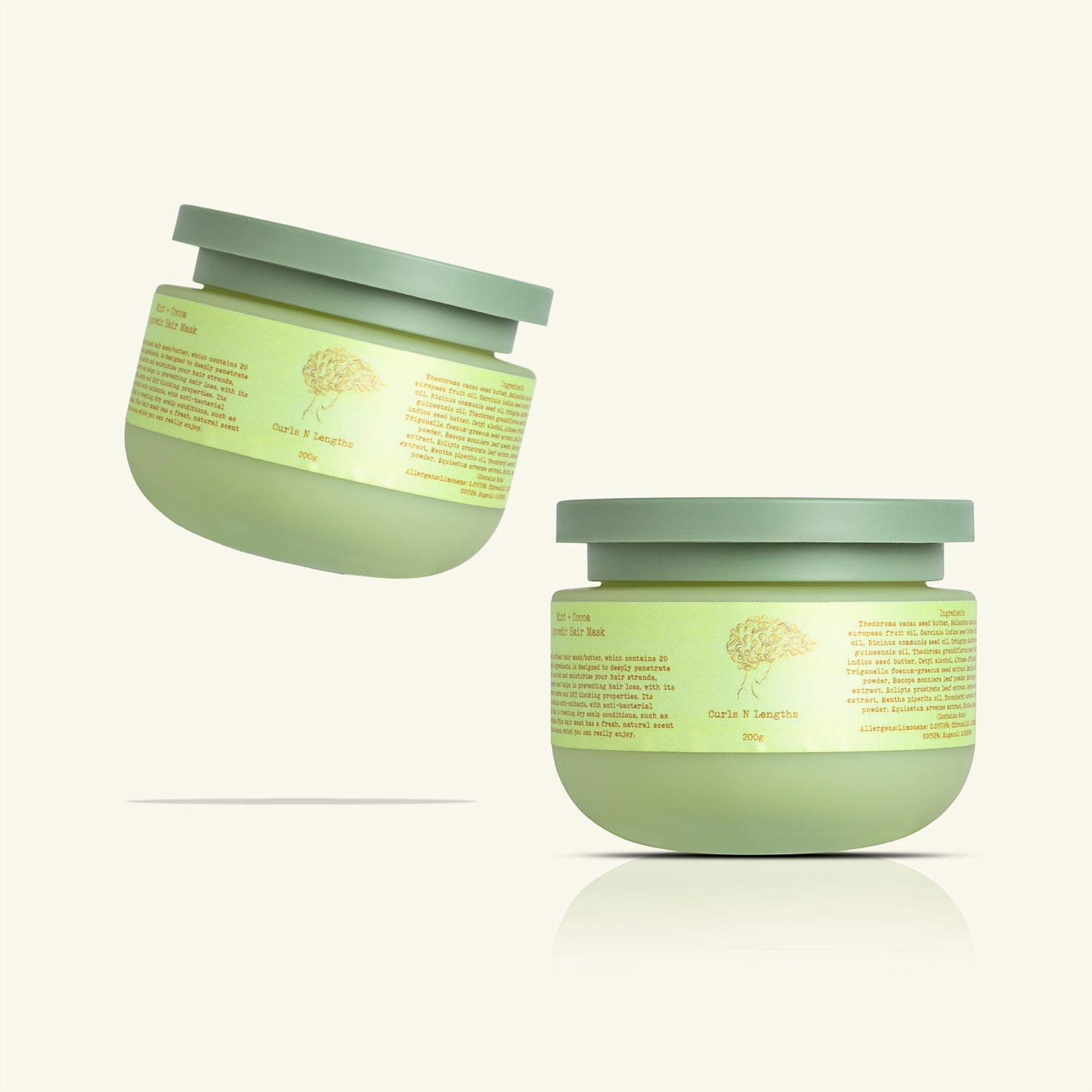
Once you know it is a surface problem, the fix is a lipid on the length, not more water. The plant-based hair butter and the mint and cocoa ayurvedic butter are where we would start.
About the Author
This guide was written by the product and education team at The Pure Curls House. We make moisture products for curly, coily and wavy hair, which is exactly why this page spends so long explaining that most dryness is not a water problem.
We could have written the usual version, where every symptom leads to a product we sell. Breakage, deposits, damage and scalp conditions are not moisture problems, and the honest version of this page says so even where we have something on the shelf nearby.
Every figure on this page comes from published measurement, and where the evidence is expert opinion rather than data, we have said so in the line itself.